
I am the Callahan Family Professor of Computer Science at Georgetown University, where I co-direct the Georgetown SecLab. My research concerns the security and privacy of communication systems that operate under adversarial conditions: how nation-states filter and surveil Internet traffic, how anonymity and censorship circumvention systems can improve privacy and Internet freedom, and how such systems can be designed to be more resiient.
Prospective Ph.D. students and postdocs: While I am always interested in working with strong students, I unfortunately do not have funding to bring on new PhD students, postdoctoral researchers, or interns at this time. While I strive to reply to all emails, the large number of requests that I receive means that I will most likely not be able to respond to inqueries from students outside of Georgetown about Ph.D. positions (which, again, are unfortunately not possible this year). I wish you the best of luck on your studies!
Research
Censorship Circumvention
Nation-states increasingly filter, classify, and block the traffic that crosses their borders. We build circumvention systems and protocols that deep-packet inspection cannot classify, proxy infrastructures that censors cannot easily block, and measurement techniques to better understand censors' behavior.
Anonymity & Tor
Our work examines how Tor and other anonymity systems behave under adversarial routing, bandwidth denial-of-service, and exit-blocking. We design defenses that improve the robustness of anonymity networks.
Privacy-Preserving Measurement
Operators of distributed systems often need statistics about their users. We design collection protocols that give useful aggregate statistics under differential privacy and secure multiparty computation, with input validation strong enough to survive malicious contributors.
Usable Security & Privacy
We study how people actually perceive, use, and (sometimes) evade security systems and privacy-preserving technologies, and what such perceptions imply for policy.
Current (or at least semi-recent) lab projects, including funding and personnel, are also described on the SecLab projects page.
Recent Highlights
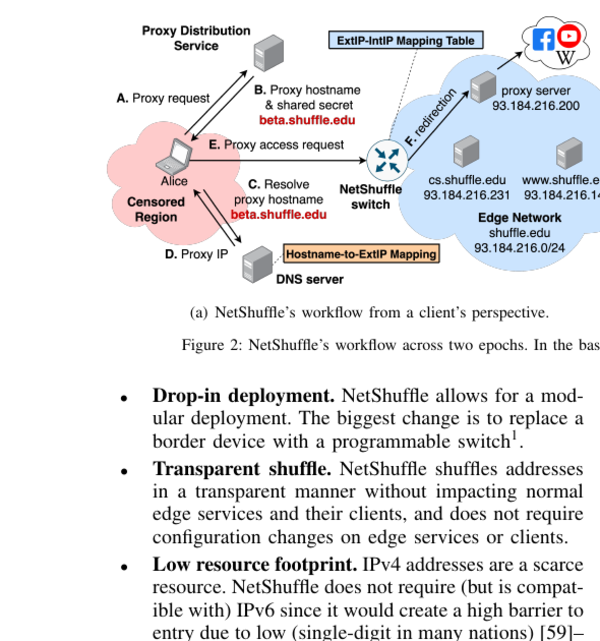
Shuffling Away Censorship at the Network Edge
NetShuffle repurposes commodity edge servers—the same infrastructure that delivers web content globally—as a distributed fleet of censorship-circumvention proxies. Because these servers are geographically dispersed and commercially essential, blocking them would cripple legitimate traffic, making censorship impractical.
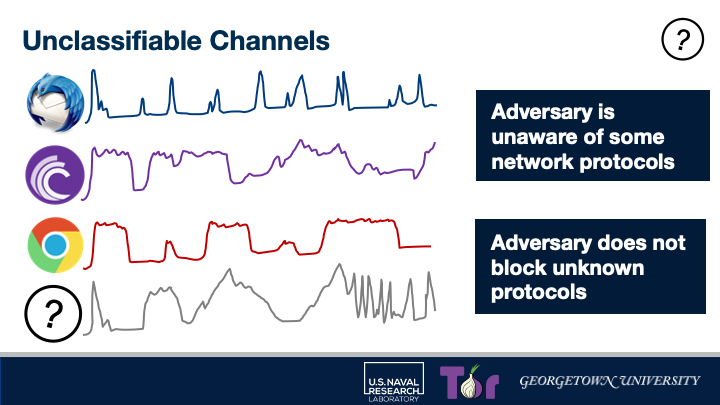
Evading Censors with Protocols They've Never Seen
Censorship filters block known protocols—but what if traffic looks like nothing in their classifier's training data? We show that generating network traffic that is statistically unclassifiable by deep-packet inspection is both practical and highly effective at evading real-world censorship systems.
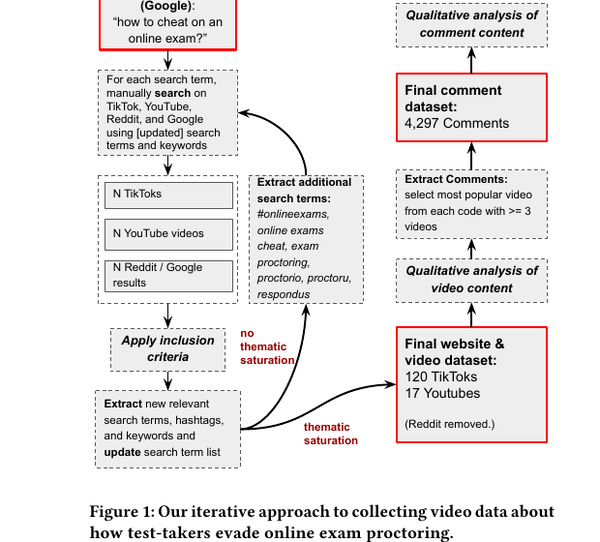
How Students Evade Online Exam Proctoring
Using iterative analysis of thousands of TikTok and YouTube videos, we document a rich community-developed playbook for defeating remote proctoring software—from browser extensions to VM tricks to phone stands. Our findings reveal how the adversarial cat-and-mouse game between proctors and students plays out in the open.
Selected Publications
All publications → Google Scholar Curriculum Vitae
News
- September 2026Punching Down: Deflation Attacks on the Tor Network (with Ran Tao, Ryan Wails, Cameron Daly, James Trombo, Micah Sherr, and Benjamin E. Ujcich) accepted to Workshop on Privacy in the Electronic Society (WPES), 2026.
- May 2026Taming Revocable Spot VM Instances with Diffused (with Zhao Zhang, Zeying Zhu, Micah Sherr, Benjamin Ujcich, and Wenchao Zhou) accepted to 42nd International Conference on Software Maintenance and Evolution (ICSME), 2026.
- February 2026Mirage: Private, Mobility-Based Routing for Censorship Evasion (with Zachary Ratliff, Ruoxing (David) Yang, Avery Bai, Harel Berger, Micah Sherr, and James Mickens) presented at Network and Distributed System Security Symposium (NDSS), 2026.
- July 2025Censorship Evasion with Unidentified Protocol Generation (with Ryan Wails, Rob Jansen, Aaron Johnson, and Micah Sherr) presented atUSENIX Security 2025.
- March 2025SCIF: Privacy-Preserving Statistics Collection with Input Validation and Full Security (with Jianan Su, Laasya Bangalore, Harel Berger, Jason Yi, Sophia Castor, Muthu Venkitasubramaniam, and Micah Sherr) accepted to Privacy Enhancing Technologies Symposium (PETS), 2025.
- August 8, 2024Modern Problems Require Modern Solutions: Community-Developed Techniques for Online Exam Proctoring Evasion (with Lucy Simko, Adryana Hutchinson, Alvin Isaac, Evan Fries, Micah Sherr, and Adam J Aviv) accepted to ACM CCS 2024.
Also
- My academic family tree, by way of the Mathematics Genealogy Project (as of April 2022).
- How to pronounce my name.